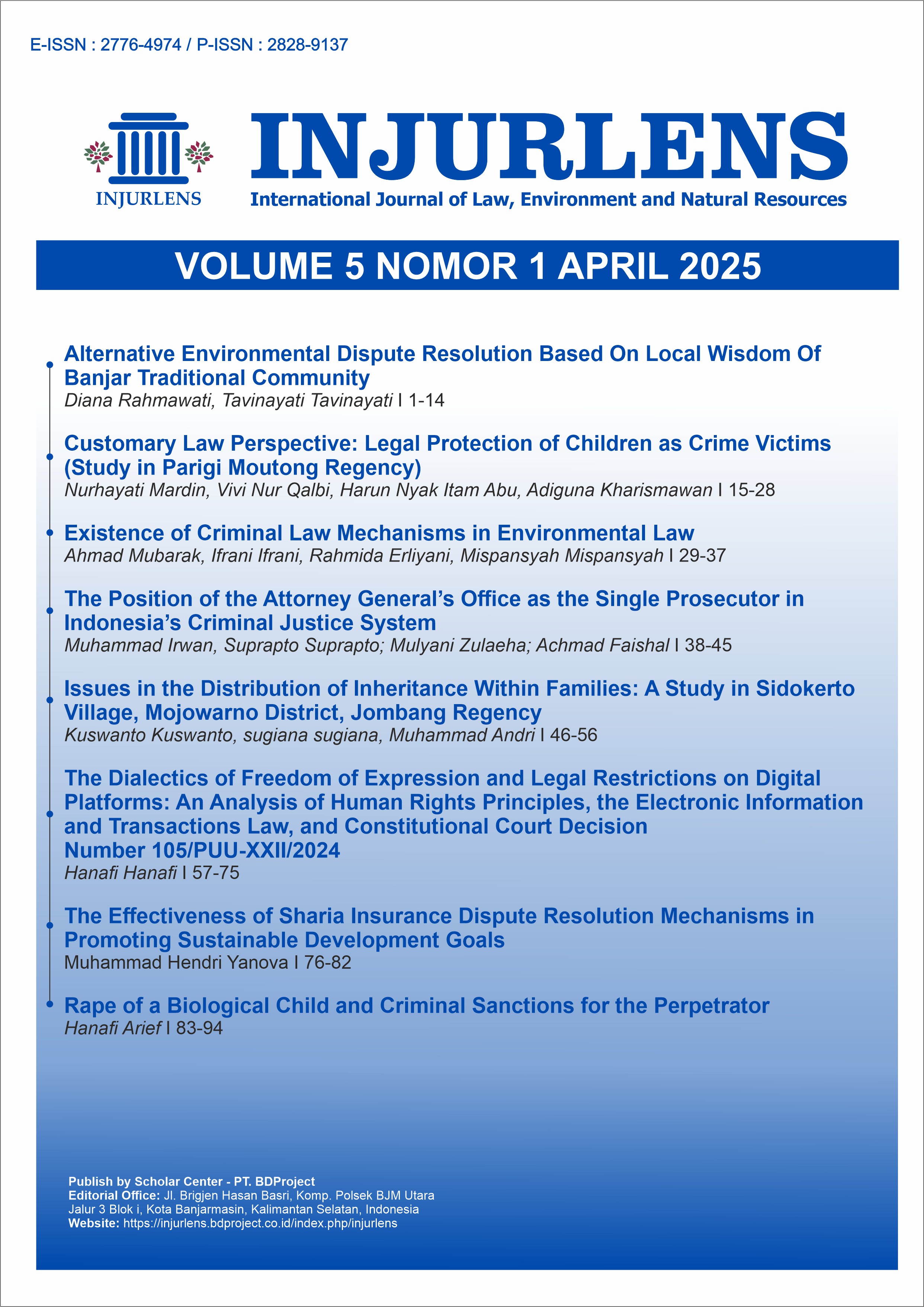
Issues in the Distribution of Inheritance Within Families: A Study in Sidokerto Village, Mojowarno District, Jombang Regency
DOI:
https://doi.org/10.51749/injurlens.v5i1.125Keywords:
Issues; Distribution; Inheritance.Abstract
Inheritance distribution within families often triggers conflicts, particularly when differing legal principles intersect, such as customary law and Islamic law. This study investigates the inheritance distribution mechanism in Sidokerto Village, Mojowarno District, Jombang Regency, focusing on the tension between customary law, which promotes equal distribution among heirs, and Islamic law, which applies a 2:1 ratio favoring male heirs. The research aims to identify the dominant factors influencing these inheritance patterns, including local traditions, legal awareness, and the socio-economic background of heirs.Using an empirical-juridical approach, the study combines a statute approach (analysis of legal texts), a case approach (review of inheritance-related disputes), and a sociological approach (examination of social practices). Primary data were collected through interviews with the village head and community leaders, while secondary data included national inheritance laws, the Compilation of Islamic Law, the Quran, and scholarly literature on inheritance practices. Findings reveal that most of the Sidokerto Village community adheres to customary inheritance law, emphasizing equal rights among heirs regardless of gender. However, a smaller portion of the population follows Islamic inheritance principles. This divergence often leads to disputes, especially when family members have differing interpretations of applicable legal norms. Factors influencing inheritance decisions include long-standing local customs, varying levels of legal knowledge, and the economic status of heirs. In most cases, inheritance issues are resolved through family deliberation, often mediated by village officials. The inheritance process typically begins with asset inventory and heir identification, serving as the foundation for distribution decisions.
Downloads
References
Al-Halawi, M. A. A. (2003). Fatwa dan Ijtihad Umar bin Khaththab; Ensiklopedi Berbagaipersoalan Fiqh. Risalah Gusti.
Ali, Z. (2011). Metode Penelitian Hukum. Sinar Grafika.
Arifin, Z. (2009). Prinsip-prinsip Operasional Bank Syariah. Azka Publisher.
Febrina, M. (2020). Penyelesaian konflik keluarga dalam pembagian harta waris: studi kasus di Desa Sedayu Kuripan Kec. Kuripan Kabupaten Lombok Barat. UIN Mataram.
Kharlie, A. T. (2013). Hukum Keluarga Islam. Sinar Grafika.
Mu’minin, M. S. (2020). Konflik Keluarga Akibat Pembagian “Harta Waris” dengan Hibah Perspektif Kompilasi Hukum Islam. SAKINA: Journal of Family Studies, 4(3), 1–12. https://urj.uin-malang.ac.id/index.php/jfs/article/view/484
Nadriana, L. (2019). AHLI WARIS PEMEGANG PERSONAL GARANSI DAPAT PAILIT.
Noor, M. (2014). Unifikasi Hukum Perdata dalam Pluralitas Sistem Hukum Indonesia. Mazahib, 13(2), 115–124. https://doi.org/https://doi.org/10.21093/mj.v13i2.385
Nugroho, S. S. (2016). Hukum Waris Adat Di Indonesia. Pustaka Iltizam 11.
Salman S, O. (2010). Hukum Waris Islam (III). Refika Aditama.
Simposium tentang Menuju Surat Keterangan Waris Yang Bersifat Nasional bagi WNI, yang di selenggarakan pada tgl 6 Mei 2009 oleh BPHN bekerjasama dengan Ikatan Keluarga Alumni Notariat-UNPAD di Jakarta)
Wawancara dengan Desa Sidokerto, Mojowarno, Kabupaten Jombang, tanggal 1 November 2024 pukul.20.00
Laporan Tahunan 2023 Mahkamah Agung RI, Halaman 106–107. diakses melalui https://kepaniteraan.mahkamahagung.go.id/images/laporan_tahunan/FA-LAPTAH_MA_2023-_low.pdf
Downloads
Published
How to Cite
Issue
Section
License
Copyright (c) 2025 Kuswanto Kuswanto, sugiana sugiana, Muhammad Andri

This work is licensed under a Creative Commons Attribution-NonCommercial-ShareAlike 4.0 International License.
Injurlens is licensed under a Creative Commons Attribution-NonCommercial-ShareAlike 4.0 International License
Articles in Injurlens are Open Access articles published under the Creative Commons CC BY-NC-SA License This license permits use, distribution and reproduction in any medium for non-commercial purposes only, provided the original work and source is properly cited. Any derivative of the original must be distributed under the same license as the original.