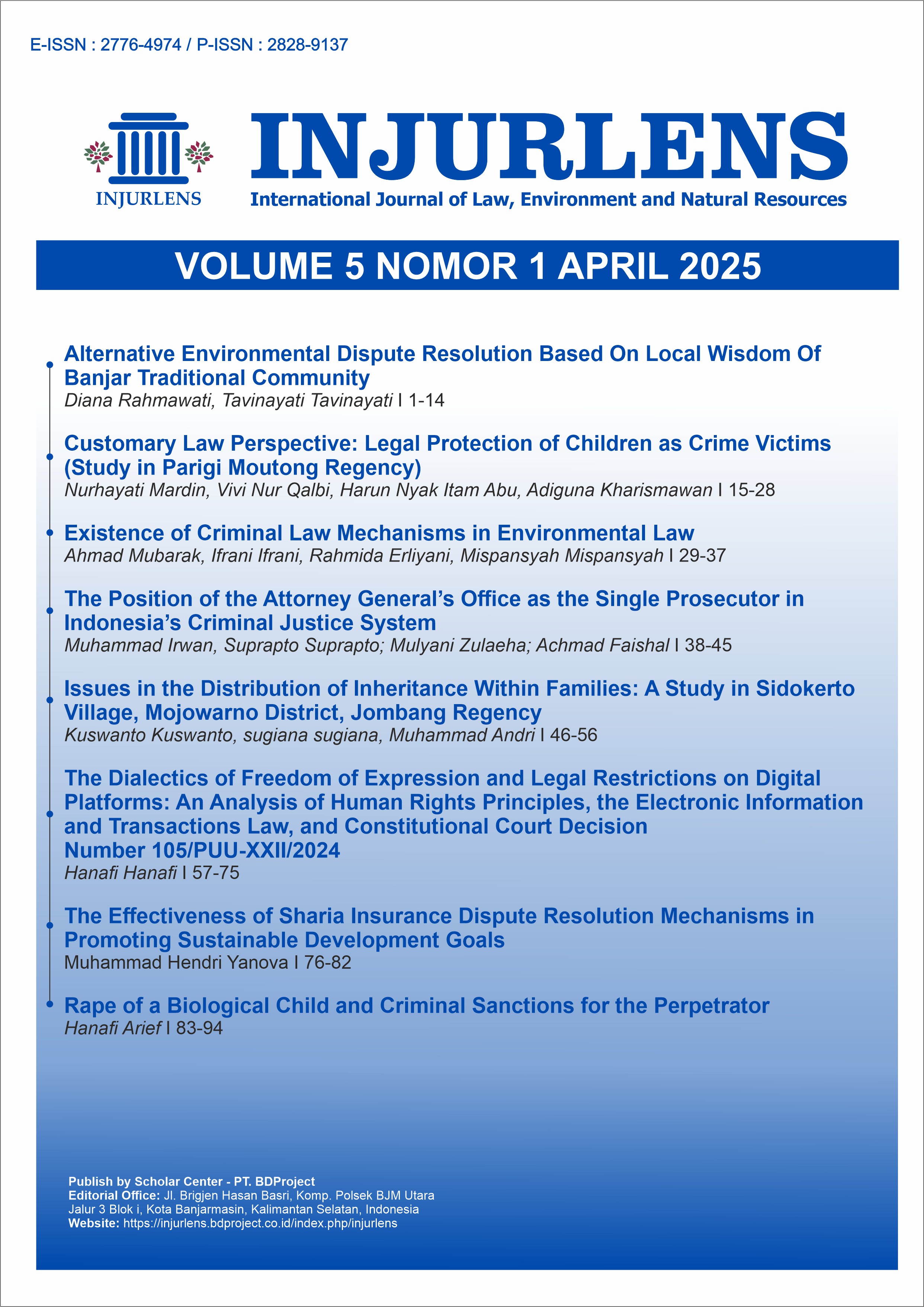
The Dialectics of Freedom of Expression and Legal Restrictions on Digital Platforms: An Analysis of Human Rights Principles, the Electronic Information and Transactions Law, and Constitutional Court Decision Number 105/PUU-XXII/2024
DOI:
https://doi.org/10.51749/injurlens.v5i1.132Keywords:
Human Rights; Freedom of Expression; Digital PlatformsAbstract
The right to freedom of expression is a fundamental aspect of human rights, guaranteed by both the Indonesian Constitution and international human rights instruments. However, this freedom is not absolute and may be subject to restrictions through regulatory frameworks such as the Electronic Information and Transactions (ITE) Law. In practice, the application of the ITE Law has sparked controversy due to the vague and overly broad language of several provisions, leading to multiple interpretations and granting excessive discretionary power to law enforcement authorities and certain parties in controlling the dissemination of electronic information. This situation has resulted in numerous cases of criminalization, raising serious concerns about the shrinking democratic space in Indonesia. This study aims to examine the legal implications of Constitutional Court Decision Number 105/PUU-XXII/2024 in relation to freedom of expression and its limitation under the ITE Law. Employing a doctrinal legal research method with a conceptual and statutory approach, the study analyzes primary legal materials and human rights theories as its analytical framework. The findings indicate that the Court’s decision constitutes a critical corrective measure by limiting the subject of defamation offenses under the ITE Law solely to individuals. This interpretation strengthens the principle of lex certa (legal certainty), curtails arbitrary interpretation in law enforcement, and reinforces the protection of freedom of expression in the digital space. Moreover, it reflects a balanced approach between safeguarding individual rights and upholding the public interest in a democratic society.
Downloads
References
Aliansi Jurnalis Independen. (2023). Koalisi Masyarakat Sipil: Revisi UU ITE Harus Terbuka, Serius Menjawab Permasalahan dan Tidak Boleh Terburu-buru. AJI Indonesia. https://aji.or.id/informasi/koalisi-masyarakat-sipil-revisi-uu-ite-harus-terbuka-serius-menjawab-permasalahan-dan
Amiruddin, & Asikin, Z. (2006). Pengantar Metode Penelitian Hukum. Raja Grafindo Persada.
Andriansyah, M. W., & Kusnadi, S. A. (2024). HAK KEBEBASAN BERPENDAPAT DI ERA DIGITAL DALAM PERSPEKTIF HAK ASASI MANUSIA. GoLRev?: Gorontalo Law Review, 7(2), 432–443. https://doi.org/https://doi.org/10.32662/golrev.v7i2.3727
Bell, M. C. (2021). John Stuart Mill’s Harm Principle and Free Speech: Expanding the Notion of Harm. Utilitas, 33(2), 162–179. https://doi.org/10.1017/S0953820820000229
Dewi, V. D. P. (2024). KEBEBASAN BERPENDAPAT DAN PELANGGARAN HAK ASASI MANUSIA DI MEDIA SOSIAL. Legal Studies Journal, 4(1), 82–92. https://doi.org/10.33650/lsj.v4i1.10861
Dyah, E. (2021). Soroti Data SAFEnet, Bamsoet Sebut Pidana UU ITE Capai 324 Kasus. Detiknews. https://news.detik.com/berita/d-5561103/soroti-data-safenet-bamsoet-sebut-pidana-uu-ite-capai-324-kasus
Fedira, R., Winharli, K. S., Shafira, A. S., Rahman, N. K., & Elvira, O. (2025). Judicial Review Pasal Karet UU ITE: Analisis Putusan Mahkamah Konstitusi No. 105/Puu-Xxii/2024 Dalam Perlindungan Hak Konstitusional Warga Negara. Media Hukum Indonesia (MHI), 3(3), 592–598. https://ojs.daarulhuda.or.id/index.php/MHI/article/view/1710
Hadi, F. (2022). NEGARA HUKUM DAN HAK ASASI MANUSIA DI INDONESIA. Wijaya Putra Law Review, 1(2), 170–188. https://doi.org/10.38156/wplr.v1i2.79
Hamid, U. (2019). UU ITE dan merosotnya kebebasan berekspresi individu di Indonesia. The Conversation. https://theconversation.com/uu-ite-dan-merosotnya-kebebasan-berekspresi-individu-di-indonesia-126043
Hartono, M. D., Wiratraman, R. H. P., Anggara, Abidin, Z., Fitri, O. R., Ayunda, Z. M., Nureda, K. R., Hermanto, M. A., Marbun, A. A. Y., Salim, R. P., Anggarawati, F. I. S., Muhidha, A. R., & Panggraito, I. G. (2021). Standar Norma dan Pengaturan Nomor 5 Tentang Hak Atas Kebebasan Berpendapat dan Berekspresi. Komisi Nasional Hak Asasi Manusia Republik (Komnas HAM RI).
Haryanto, E. (2025). Implikasi Hukum Pasca Putusan MK Nomor 105/PUU-XXII/2024 tentang Perubahan Sejumlah Pasal dalam Undang-Undang ITE. JURNAL ILMIAH HUKUM DIRGANTARA, 15(2), 1–10. https://doi.org/10.35968/jihd.v15i2.1528
Hidayat, B., Ufran, U., & Rodliyah, R. (2023). Kebijakan Legislasi “Cyber Sex” Pada Forum Anonymous Chatbot Telegram Menurut Undang-Undang ITE. Indonesia Berdaya, 4(2), 477–494. https://doi.org/10.47679/ib.2023431
Human Rights Watch. (2010). Turning Critics into Criminals: The Human Rights Consequences of Criminal Defamation Law in Indonesia. HRW.
Kusuma, E. (2023). Kebebasan Berpendapat dan Kaitannya Dengan Hak Asasi Manusia (HAM). Sanskara Hukum Dan HAM, 1(03), 97–101. https://doi.org/10.58812/shh.v1i03.63
Kusumo, V. K., Junia, I. L. R., Prianto, Y., & Ruchimat, T. (2021). PENGARUH UU ITE TERHADAP KEBEBASAN BEREKSPRESI DI MEDIA SOSIAL. Prosiding SENAPENMAS, 1069. https://doi.org/10.24912/psenapenmas.v0i0.15141
Mahkamah Konstitusi Republik Indonesia. (n.d.). Ketentuan Kebebasan Berpendapat Dalam UUD. Mahkamah Konstitusi Republik Indonesia. https://www.mkri.id/index.php?page=web.Berita&id=16828
Marwandianto, M., & Nasution, H. A. (2020). Hak Atas Kebebasan Berpendapat dan Berekspresi dalam Koridor Penerapan Pasal 310 dan 311 KUHP. Jurnal HAM, 11(1), 1–25. https://doi.org/10.30641/ham.2020.11.1-25
Mill, J. S. (2002). On Liberty (paperback). John W. Parker and Son di London.
Munir. (2024). Kajian Pasal 27 A UU No. 1 Tahun 2024 Tentang Perubahan Kedua Undang-Undang Nomor 8 Tahun 2008 Tentang ITE. Fundamental: Jurnal Ilmiah Hukum, 13(2), 1–12. https://doi.org/10.34304/jf.v13i2.284
Nanda, D. H., & Hariyanta, F. A. (2022). PROBLEMATIKA OPERASIONALISASI DELIK PASAL 27 AYAT (3) UU ITE DAN FORMULASI HUKUM PERLINDUNGAN FREEDOM OF SPEECH DALAM HAM. Jurnal Hukum Dan Pembangunan Ekonomi, 9(2), 214. https://doi.org/10.20961/hpe.v9i2.52779
Nizam Tazmi. (2025). Protection of Human Rights in Freedom of Opinion and Expression on Social Media. JUSTICES: Journal of Law, 4(1), 32–43. https://doi.org/10.58355/justices.v4i1.141
Nowak, M. (2005). U.N. Covenant on Civil and Political Rights: CCPR Commentary (2nd ed.). N.P. Engel.
Rahmawati, N., Muslichatun, M., & Marizal, M. (2021). KEBEBASAN BERPENDAPAT TERHADAP PEMERINTAH MELALUI MEDIA SOSIAL DALAM PERSPEKTIF UU ITE. Widya Pranata Hukum?: Jurnal Kajian Dan Penelitian Hukum, 3(1), 62–75. https://doi.org/10.37631/widyapranata.v3i1.270
Sahid, M. (2018). Kebijakan Formulasi Sanksi Pidana dalam Penanggulangan Tindak Pidana Siber Berdasarkan Undang-Undang Informasi dan Transaksi Elektronik. AKTUALITA, 1(1), 205–221. http://download.garuda.kemdikbud.go.id/article.php?article=2966246&val=26430&title=Kebijakan Formulasi Sanksi Pidana Dalam Penanggulangan Tindak Pidana Siber Berdasarkan Undang-Undang Informasi Dan Transaksi Elektronik
Sari, E. L., & Widyastuti, L. (2021). Unilateral Judgment Through Social Media in The Perception of Diversity and Human Rights. Majalah Hukum Nasional, 51(2), 131–153. https://doi.org/https://doi.org/10.33331/mhn.v51i2.146
Soekanto, S., & Mamudji, S. (2013). Penelitian Hukum Normatif?: Suatu Tinjauan Singkat (Cet. 4). Raja Grafindo Persada.
Wahyuni, R., & Sharfina Desiandri, Y. (2024). Hak Asasi Manusia (HAM) Pada Kebebasan Berpendapat/Bereksperesi dalam Negara Demokrasi di Indonesia. Jurnal Sains Dan Teknologi, 5(3), 961–966. https://doi.org/10.55338/saintek.v5i3.2422
Yacob, C. Y. (2024). Problematika Penerapan Pasal 28 Ayat (2) Undang-Undang Nomor 19 Tahun 2016 Tentang Informasi dan Transaksi Elektronik. Jurnal Hukum Legalita, 6(2), 163–170. https://doi.org/10.47637/legalita.v6i2.1413
Downloads
Published
How to Cite
Issue
Section
License
Copyright (c) 2025 Hanafi Ramsi

This work is licensed under a Creative Commons Attribution-NonCommercial-ShareAlike 4.0 International License.
Injurlens is licensed under a Creative Commons Attribution-NonCommercial-ShareAlike 4.0 International License
Articles in Injurlens are Open Access articles published under the Creative Commons CC BY-NC-SA License This license permits use, distribution and reproduction in any medium for non-commercial purposes only, provided the original work and source is properly cited. Any derivative of the original must be distributed under the same license as the original.